Process 101: Solvent Extraction
Solid–liquid extraction is a fundamental separation process that has been applied since ancient times to isolate components from natural sources. The history of natural product extraction dates back to Mesopotamia and Egypt, where the production of perfumes and pharmaceutically active oils and waxes was a significant activity. With this deep historical background, the process forms the foundation of today’s modern food, pharmaceutical, cosmetic and chemical industries.
Definition and Fundamentals of Solid–Liquid Extraction
Solid/liquid extraction is a separation process in which the target compound is dissolved and removed from a solid matrix using a liquid solvent.


For the separation to occur, a series of steps must take place during the interaction period between the solute-containing particle and the solvent:
- Separation of the extract and the solid
- Penetration of the solvent into the solid matrix
- Dissolution and/or disintegration of the components
- Transport of the dissolved substance out of the solid matrix
- Transfer of the target component from the outer surface of the solid into the solution
- Removal of the extract from the solid matrix (i.e., displacement of the extract phase)
Critical Parameters Determining Extraction Efficiency
1. Preparation of Solid Material (Size Reduction)
Pre-treatments such as crushing, breaking, or grinding (particle size reduction) may be required to improve extraction efficiency. The size of the solid material should enhance the contact between the target component and the solvent. However, if the material is ground too finely, the solids may compact and hinder the free flow of the solvent. Therefore, optimizing the particle size is essential.
The size-reduction process is typically carried out using cutting mills. After grinding, the particles are conveyed to a cyclone with the help of a fan, separated from the air, and classified using a vibrating screen. The exhaust air is purified by a cartridge filter to minimize product loss and to protect both the user and the environment.
2. Solvent Selection
The selection of the solvent is based on properties such as capacity, selectivity, chemical inertness, thermophysical characteristics, flammability, toxicity, cost, and availability. In process design, the polarity relationship between the component and the solvent plays a decisive role. The ideal solvent must be chosen in accordance with the characteristics of the target compound.

3. Operating Temperature
Temperature should be high enough to increase the solubility of the solute in the solvent. However, it must not be so high as to cause solvent loss, extraction of undesired substances or degradation of sensitive compounds.
4. Equipment Selection
Equipment choice depends on the operating mode (batch or continuous), the type of solids (fixed bed, percolation, full immersion, intermittent drainage, or dispersed/mobile contact) and the process configuration (single-stage or multi-stage). Technical and economic feasibility of an extraction process is determined when equipment size, operating conditions, solvent flow rates and extraction yields are known.
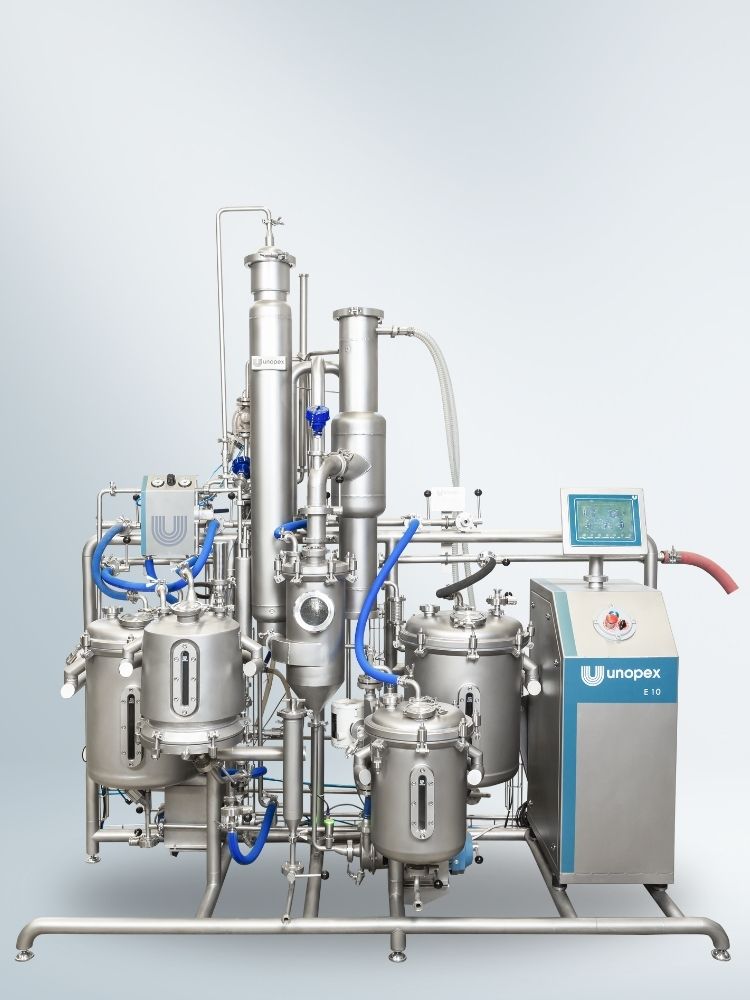
Unopex E 10 Extraction Miniplant Designed for the food, pharmaceutical, cosmetics, chemical industries and academic institutions, the Unopex E 10 Miniplant is a multifunctional facility developed for the extraction of solid raw materials in small batches. It is suitable for obtaining a wide range of valuable products such as colorants, flavors, essences, and active ingredients.
The Unopex E 10 contains a single percolator and integrates fundamental extraction methods such as percolation, maceration, and steam distillation, along with filtration and extract concentration within the same system. This unit is used for the recovery of natural extracts, the concentration of liquid extracts, and the recovery of solvents.
Applications, Raw Materials and Products
Doğal ürünlerin ekstraksiyonu, çiçekler, yapraklar, otlar, şifalı bitkiler, kökler, kabuklar, tohumlar, meyveler ve sebzeler dahil olmak üzere çok çeşitli bitkisel hammaddeler kullanılarak gerçekleştirilir. Bu süreçlerin nihai ürünleri arasında doğal ekstraktlar, aktif bileşenler, tatlar, aromalar, oleoresinler, renklendiriciler ve uçucu yağlar yer alır.
Extraction Steps
1. Extraction
The raw material is manually loaded through the opening at the top of the extractor. The materials are extracted with water and/or organic solvents at a specified temperature and duration. During percolation, the solvent can be preheated and continuously reheated. The flow direction can be freely selected and adjusted depending on the pressure. In the case of steam distillation, the distillate is condensed and collected for phase separation. When using organic solvents, steam stripping can be applied to minimize solvent loss and enable recovery. At the end of the extraction cycle, the micelle/extract is drained, followed by vacuum removal of any residual liquid from the wet cake, and the bottom cover is opened for discharge.
2. Filtration
At the end of the extraction cycle, the micelle/extract is pumped through a wedge-wire micro-screen with a mesh form 25 to 500 µm to separate the suspended solids. This integrated filtration ensures a clear extract is obtained.
3. Evaporation (Concentration)
The concentration of the extract is carried out in a single-effect falling film evaporator. The liquid begins to boil as the tubes are heated externally by steam, resulting in partial evaporation. The liquid and vapor are separated at the bottom and in the centrifugal droplet separator. The vapor is condensed in the condenser and can be recirculated back to the extraction process. The concentrated product is directed to the next step or recirculated for further concentration. Vacuum conditions can be adjusted to lower the boiling point and minimize thermal impact. Falling film evaporators are highly suitable for sensitive products due to low temperature differentials, short residence time, minimal hold-up, and a small footprint. Additionally, a density meter is integrated into the concentrate line to facilitate achieving the target concentration.

Process Control and Safety
The Unopex E 10 features a PLC-based automatic control system. A stainless steel control panel is integrated into the unit. Extraction, filtration, and evaporation operations are managed via a user-friendly large touchscreen. All process parameters can be continuously recorded. The extraction unit can be cleaned in place (CIP) using water and appropriate chemicals, and can be steam-sterilized after cleaning.